A no-nonsense beginner racket that actually earns its price.
Our Take
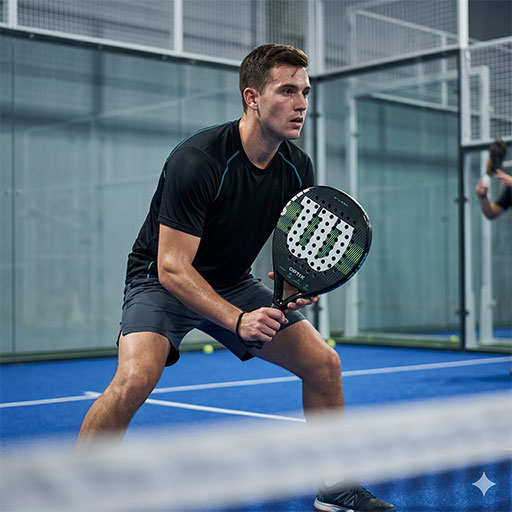
The Wilson Optix V1 is one of the more honest beginner rackets on the market. It doesn't make promises it can't keep — and that's exactly what makes it worth recommending to new players.
The standout feature is Wilson's Sharp Hole Technology, a precision-drilled string bed pattern designed to increase ball contact time and give you a bit more feel on each shot. For beginners, this translates to a more forgiving response on off-center hits — which is most of them when you're starting out.
At 355g, the Optix V1 sits at the lighter end of the beginner-friendly range. You'll be able to play a full session without your arm complaining, and the lower weight makes it easier to react quickly at the net. The round head shape keeps the sweet spot wide, so you spend less time correcting and more time developing your game.
This isn't a racket you'll outgrow in your first month — it's built to carry you through the learning curve and into your first real improvement phase. For $119, it's a solid investment that gets out of your way and lets you focus on learning padel, not compensating for your equipment.
Wilson Optix V1 - Specs
Wilson Optix V1
~$119 (Amazon / authorized U.S. retailers)
Player best for

WHY THIS WORKS
The Wilson Optix V1 is engineered around a straightforward idea: give a new padel player the most forgiving possible experience so they can focus on learning the game, not fighting their equipment. Every design decision in this racket serves that goal. Here's what each piece of tech is actually doing:
Of the three padel racket shapes — round, teardrop, and diamond — round gives you the largest, most centered sweet spot. When you're new to padel, the vast majority of your contact is going to be off-center. A round head means those off-center hits still go where you intend them, rather than flying wide or dropping short. It's not the shape that generates maximum power — that's diamond. But for a beginner, forgiveness beats raw power every time. You'll develop the swing mechanics for power naturally. The round head gives you the runway to do it without punishing every imperfect contact along the way.
Sharp Hole Tech is Wilson's precision perforation pattern on the hitting face. The holes are drilled at specific angles to increase the dwell time of the ball on the strings — meaning the ball stays in contact with the face fractionally longer on each hit. For a beginner, this translates to two practical benefits: more feel and feedback on each shot, and a slightly softer, more controlled response on mishits. It also reduces the overall weight of the face, which makes the racket feel quicker to swing than the 355g number suggests.
EVA foam is the padel equivalent of a cushioned sole. It absorbs more impact energy than harder core materials — which means less vibration traveling from each hit through the frame, into your wrist and elbow. Beginners tend to underestimate how much cumulative vibration adds up over an hour of padel. The rally pace is faster than tennis, the court is smaller, and you're making far more contacts per session than you expect. EVA foam is the buffer that keeps your arm feeling fine the next day, even through that adjustment period.
Fiberglass is softer on contact than carbon fiber. It gives the ball slightly more dwell time on the face, which produces a more controlled, placeable response rather than a harsh, pingy redirect. For a player still developing their swing mechanics, this is genuinely useful — you can start to feel where the ball is going rather than just hoping the contact holds. Fiberglass also keeps vibration lower than carbon, which pairs well with the EVA core's arm protection.
Standard padel handles are shorter than tennis handles, which can feel disorienting if you have any racket sport background. The V1's extended handle brings the grip length closer to what tennis players are used to, reducing the adjustment friction. Even if you've never played tennis, the slightly longer handle gives you a bit more natural grip security without adding significant weight or changing the balance point meaningfully.
HOW IT PLAYS
The V1 feels calm and predictable at the net. The round head and EVA core combination absorbs the pace off a hard-hit ball well — blocking or redirecting a smash doesn't rattle the frame or send shock back through your hand. Volleys feel soft and controlled rather than springy or unpredictable. For beginners who are still figuring out court positioning and net mechanics, this consistency is genuinely helpful.
Groundstrokes from the baseline are reliable and consistent. You won't generate the pace that a teardrop or diamond racket produces on a clean swing, but the ball goes where you intend it — which matters more at this stage than raw power. The Sharp Hole Tech gives you enough feel to start developing directional intent on your shots. As your swing mechanics improve, you'll feel the V1 start to approach its ceiling, which is the natural signal to step up.
At 355g with a forgiving head shape, overhead mechanics are manageable even as a beginner. The racket doesn't feel heavy or unwieldy through the swing, and smashes land with enough pace to be competitive without the ball going unpredictably long. The round head's wide sweet spot helps here too — off-center overheads still land in the court.
This is where the EVA core and fiberglass face combination really justify themselves. Over 60–90 minutes of play, vibration fatigue stays low. The V1 is one of the more arm-friendly rackets at this price point — if you're playing two or three times a week, your elbow and wrist won't be the limiting factor in how much you can train. For players new to racket sports who haven't yet built up the tendon resilience that experienced players have, this matters more than most people realize going in.
Wilson Optix V1 vs. V2 Lite — which one is right for you?
The V1 and V2 Lite share the same core technology. If you're coming from tennis and the standard handle has felt wrong, the $20 upgrade to the V2 Lite is worth it. If you're a complete beginner with no racket sport background, the V1 at $119 is the smarter starting point — you'll get the same forgiveness and arm comfort without paying for a feature you don't need yet.
Should you buy the Wilson Optix V1?
Yes — if you're a complete beginner or buying a first padel racket for someone else, the Wilson Optix V1 is one of the most honest recommendations we can make. Round head. EVA foam core. Fiberglass face. Sharp Hole Tech. $119. Every decision in this racket points at the same thing: getting out of your way so you can focus on learning padel rather than fighting your equipment. If you're coming from tennis specifically, consider spending the extra $20 on the V2 Lite for the tennis-optimized handle. But if you're starting from scratch, the V1 is the right call — and it'll carry you through your first six to twelve months before you start feeling its ceiling.
Affiliate disclosure: We earn a small commission at no extra cost to you.
Keep exploring