
Named after one of padel's greats. Built for players ready to take the game seriously — without going pro.
★ Named after Fernando Belasteguín — 16x World No. 1, widely considered the greatest padel player of all time.
Our Take
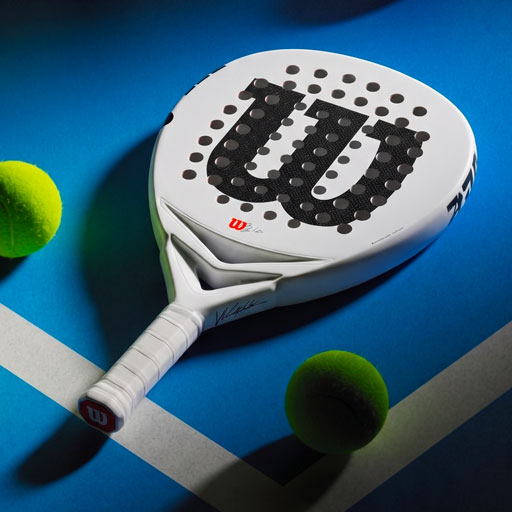
The Wilson Bela Team carries the name of Fernando Belasteguín — widely considered the greatest padel player of all time. That lineage matters, because this racket is designed to reflect his playing philosophy: precise, controlled, and built around shot quality over raw power.
This is a step-up racket in the truest sense. It's not for complete beginners, but it's also not demanding the way a pro-spec racket can be. The Bela Team is designed for players who've gotten comfortable on the court, started developing a real game style, and want equipment that responds to that progress rather than fighting it.
The construction is noticeably more refined than the Optix line. You'll feel it in the feedback on each shot — there's more information coming back to your hand, which is what helps intermediate players dial in their technique faster. The balance point is tuned for control-first play, rewarding touch and placement over swinging hard and hoping.
At $160, the Bela Team sits at the upper edge of the beginner-to-intermediate range, and it's priced that way for a reason. If you're six months into padel and you can feel yourself hitting a ceiling with your current racket, this is the logical next move — a racket with pro DNA that meets you where you are, not where you wish you were.
Wilson Bela Team - Specs
Wilson Bela Team
~$160 (Amazon / authorized U.S. retailers)
Player best for

WHY THIS WORKS
The Wilson Bela Team isn’t trying to be the most forgiving racket on the market. It’s trying to be the most responsive one at this price point — a racket that gives you real information back on every shot and rewards improving technique with better results. Here’s what each design decision is doing:
Fernando Belasteguín held the World No. 1 ranking for 16 consecutive years — the longest reign in the sport’s history. His game was built on precision, court intelligence, and shot placement rather than brute power. The Bela Team carries that philosophy into its design: balance point, face material, and frame tuning are all oriented around control-first play. This isn’t a racket that rewards wild swings. It’s a racket that rewards players who are starting to develop a real padel game style and want equipment that reflects that.
Sharp Hole Tech is Wilson’s precision perforation pattern on the hitting surface. On the Optix line it’s primarily a weight-reduction tool — on the Bela Team, it works alongside the more refined frame construction to improve feel and dwell time. The result is more tactile feedback on each shot: you can feel the difference between a clean strike and an off-center one, which is exactly the kind of information intermediate players need to accelerate their technique development. When you can feel what’s happening, you can correct it faster.
Fiberglass gives the ball slightly longer contact time on the face compared to carbon fiber — a softer, more controlled response that prioritizes placement over explosive pace. On a control-oriented racket like the Bela Team, this is a deliberate choice. Players at the 6–12 month mark are typically working on directional consistency and touch shots — volleys, lobs, angled drops. The fiberglass face rewards all of those. If you’re looking for maximum power output, carbon fiber is the material you want. But if you’re building a technically complete game, fiberglass at this frame quality is the smarter tool.
The Bela Team’s balance point sits toward the handle end of the frame rather than the head. Lower balance means the racket feels lighter in the swing and more maneuverable on quick exchanges — net duels, fast volleys, reactive blocks. It trades some of the natural momentum a head-heavy racket generates on groundstrokes for better control and faster recovery between shots. For a player developing consistent net play and starting to move around the court with real intention, this tradeoff is almost always the right one.
HOW IT PLAYS
This is where the Bela Team earns its price. The control-focused balance makes the racket feel quick and nimble at the net — you’re not fighting head weight through fast exchanges. Volleys feel precise and deliberate rather than reactive and hoping. The fiberglass face gives you enough dwell to redirect a hard-hit ball with real intention rather than just getting it back. For players who are starting to understand that padel is won at the net, the Bela Team rewards that understanding immediately.
Groundstrokes are consistent and placement-oriented. Don’t expect the same pop as a power-biased racket — the Bela Team’s balance and face material are tuned for control, not pace generation. What you get instead is real directional precision: cross-court angles, down-the-line shots, and drive volleys all feel like you’re painting a target rather than hitting and hoping. For players building a technically complete baseline game, that consistency compounds quickly over time.
The control-focused balance keeps the Bela Team manageable overhead. Smashes are accurate rather than blistering — you’re not getting pro-level pace, but you’re hitting smashes that land where you want them, which at the intermediate stage is more valuable. The fiberglass face also helps here: you can take pace off an overhead and place a drop smash rather than just hammering the ball as hard as possible and hoping it stays in.
The Bela Team plays comfortably over long sessions. The fiberglass face keeps vibration lower than a carbon-face frame at this price range, and the control balance means you’re not muscling the racket through every swing to generate pace. Players who train two or three times a week will find the arm feel stays manageable even as session intensity increases. It’s a racket you can grow into rather than one that fights back as your game develops.
Wilson Bela Team vs. the Optix line — is the upgrade worth it?
The short version: all three Wilson beginner-to-intermediate rackets share the same core tech. What the Bela Team adds is pro-lineage frame construction and a control-tuned balance point. If you’ve maxed out your Optix and want a racket that gives you more information on each shot rather than just more forgiveness, the $40 upgrade to the Bela Team is worth it. If you’re still in your first few months, stay on the Optix and come back when you’re ready.
Should you buy the Wilson Bela Team?
Yes — if you’ve been playing padel for six months or more and you’re starting to feel like your beginner racket is limiting rather than supporting your game. The Bela Team is the clearest step-up in the Wilson lineup: refined frame construction, control-first balance, and the kind of shot feedback that actually helps you improve rather than just absorbing your mistakes. It’s not the right racket for a complete beginner — the Optix V1 exists for that. And it’s not a power racket for players chasing pace. But for the player who’s developing real technique and wants a racket with pro DNA that meets them where they are, the Bela Team at $160 is one of the better investments you can make at this stage of your padel development.
Affiliate disclosure: We earn a small commission at no extra cost to you.
Keep exploring