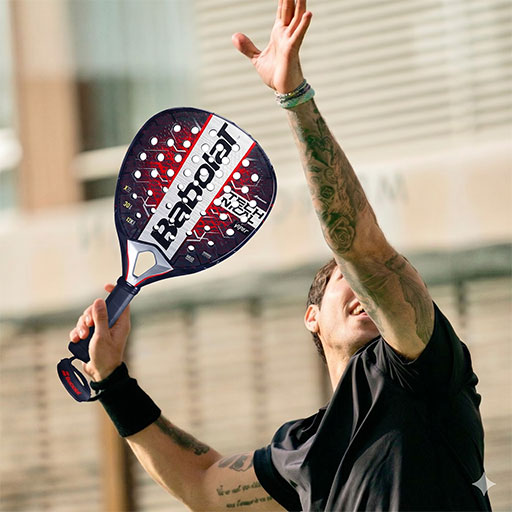
The Babolat Technical Viper sits between the beginner-friendly Contact and Babolat's competitive-tier rackets. It's designed for players who have moved past the absolute basics — who can rally consistently and are starting to want more punch on their smashes and volleys — but who still benefit from a forgiving frame.The key question this review answers: are you actually ready for the Technical Viper? Buying up too soon is one of the most common mistakes padel players make. We'll tell you exactly where you need to be to get the most out of this racket — and when to stick with the Contact a little longer.
Quick Stats
Buy it if:
You've been playing 3+ months, feel confident on court, and want more power on your smashes and finishing shots.
Skip it if:
You're still working on consistency and basic positioning — buy the Contact first and come back to this in a few months.
Babolat Viper — technical specs
Babolat Technical Viper (2025/2026)
~$160–180 (Amazon / authorized U.S. retailers)
Player best for

THE DETAILED BREAKDOWN
The shift from round to teardrop is the most significant change between the Contact and the Technical Viper. A teardrop head moves the sweet spot upward and reduces its overall size compared to a round head.
In practice: you get more power on centered hits, and less forgiveness on off-center hits. The Technical Viper's teardrop is on the more forgiving end of the spectrum for its shape category — it still plays closer to a control racket than a diamond-head power racket. That's the right call for this price point and target player.
The Technical Viper uses a carbon and fiberglass hybrid frame. Carbon fiber is stiffer, which means more energy is transferred from the frame to the ball on impact — translating to more pace with the same swing speed.
The tradeoff: carbon frames transmit more vibration to your arm. The hybrid construction on the Technical Viper softens this compared to a full-carbon frame, but it's still a notch more demanding than the Contact. For most players with 3–6 months of play, it's not a meaningful concern.
The Contact's low balance keeps weight toward the handle for maximum control. The Technical Viper's mid balance distributes weight more evenly — giving you more head momentum on volleys and smashes while still being manageable from the baseline.
You'll feel this difference most on overhead smashes and finishing shots. The Technical Viper has noticeably more punch than the Contact when you're in position.
Most players transitioning from the Contact notice the same thing in their first 3–5 sessions: their short game feels slightly off while their smash feels immediately better. The teardrop head rewards you on attacking shots; it takes a little recalibration on touch shots and lobs.
This recalibration period is normal and typically short — a week or two of regular play. It's not a reason to avoid the upgrade.
The Technical Viper is a bridge racket — better than a beginner racket, not yet in the territory of club-competitive or pro-spec frames. Think of it as the racket you'll play with while your game is actively developing. Most players who start here move to a higher-tier frame after 12–18 months of consistent play.
That's not a knock — it's excellent value for its tier. It just means you should feel good about buying it as a stepping stone rather than a permanent option.
HOW WE RATED IT
Babolat Technical Viper — score breakdown
THE HONEST SUMMARY
Babolat Technical Viper — pros and cons
IS THIS THE RIGHT RACKET FOR YOU?
• You've been playing padel regularly for 3–6 months and feel confident in your basic positioning and timing
• You're coming from tennis or squash with existing racket mechanics — you may be ready even if newer to padel
• You feel like your current racket is holding back your smash or overhead gameYou want to grow into a racket for the next 12–18 months, not just the next few sessions
• You've tried the Contact and feel it's become too 'soft' on contact
• You're still working on basic consistency — getting the ball over the net and in court reliably
• You have elbow, wrist, or shoulder sensitivity — the Contact's fiberglass frame is significantly more protective
• You've only played 5–10 times — the Technical Viper won't accelerate your development at this stage
THE DETAILED BREAKDOWN
Babolat Contact vs. Technical Viper — the key decision
The choice comes down to one honest question: are you consistently making solid contact in the center of the racket?
If Yes:
The Technical Viper will reward you. The teardrop head will add real pace and your mechanics will benefit from the slight reduction in forgiveness.
If No:
The Contact is still your racket. A more demanding frame won't fix technique; it'll just expose gaps and frustrate your development.
See the full Babolat Contact vs. Technical Viper comparison on the Babolat brand page
READY TO BUY?
The Babolat Technical Viper — the step-up racket for developing players.
Available on Amazon with Prime shipping. Prices on Babolat rackets can shift 10–15% seasonally — check current pricing below.
Affiliate disclosure: PadelRacketHub earns a small commission on purchases made through our links — at no extra cost to you. We only recommend rackets we'd hand to a friend.
Related guides you might find useful
BUYING GUIDE
How to Choose a Padel Racket: Plain-English Guide for New Players
Shape, weight, balance — decoded without the jargon.

COMPARISON
Babolat Contact vs. Technical Viper — Is the Upgrade Worth It?
We break down the real difference between the two models.
REVIEW
Babolat Contact Review — The Best Beginner Padel Racket?
Not sure you're ready for the Viper? Here's the case for starting with the Contact.