
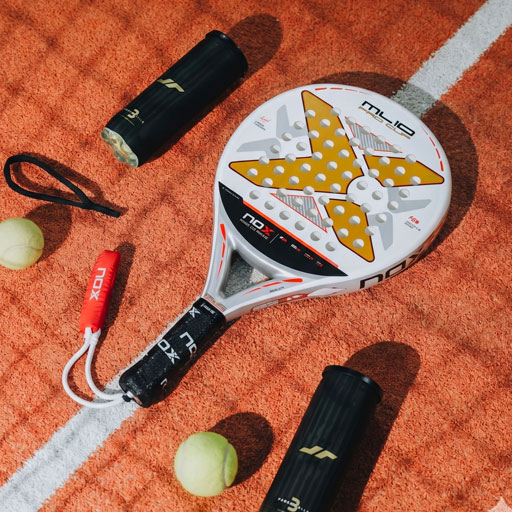
Step-Up / Competitive Pick

NOX ML10 Pro Cup Review: The NOX Padel Racket U.S. Competitive Players Are Actually Using

Home / NOX ML10 Pro Cup Review

A teardrop carbon frame named after a touring pro that actually lives up to the billing — for players at the right stage of their game. Here's what makes it earn the price tag.

Our Verdict

The NOX ML10 Pro Cup is one of those rackets you see consistently showing up in club environments where people are serious about the game — players taking weekly lessons, entering local tournaments, playing three or more times a week. That's not an accident.

It's a teardrop carbon frame that delivers what better technique deserves: cleaner power transfer, a more direct and responsive feel at contact, and the kind of consistent performance that rewards investment in your game. The trade-off is honest — you need cleaner mechanics to get the best from it. But when your technique is there, this racket shows it.

At $180–200, the ML10 Pro Cup is a meaningful investment. For intermediate and competitive players ready for it, it's one of the best values NOX makes.

9.3
PadelRacketHub Score
Value for Money9/10
Power & Response9/10
Control9/10
Durability9/10
Arm Comfort7/10

Affiliate link. We earn a small commission at no extra cost to you.

Key Specs at a Glance

NOX ML10 Pro Cup

~$180–200 (Amazon / authorized U.S. retailers)

Player best for

THE DETAILED BREAKDOWN

What makes the NOX ML10 Pro Cup worth the investment

Carbon fiber: more power, more feedback, higher ceiling

Carbon fiber is stiffer than fiberglass, and that stiffness translates directly into power transfer at contact. When you hit cleanly — centered on the face, with good mechanics — the ML10 Pro Cup rewards you in a way softer rackets don’t. The energy goes into the ball, not into the frame. The feel is crisper, more responsive, and more satisfying for players who have put in the work on their technique.

The trade-off: stiffer also means less forgiving. Off-center hits don’t absorb the same way. This is why we don’t recommend carbon for beginners — it exposes weaknesses in your swing rather than masking them. But for an intermediate player with solid fundamentals, it’s the right call.

Pro-named, but actually usable by club players

A lot of pro-signature rackets are vanity products — they carry a famous name but are tuned for touring professionals playing at a level most club players will never reach. The ML10 Pro Cup bucks that trend. It's named after Miguel Lamperti, yes, but the weight, balance, and specs are calibrated for serious recreational players. It's accessible without being dumbed down.

Why it shows up consistently in U.S. club environments

The ML10 Pro Cup earns loyalty through consistency. Players who buy it tend to stick with it. It's not the flashiest racket on the shelf, and it doesn't try to be. It just performs — reliably, session after session. For a player who's entered a few local tournaments, takes weekly lessons, or plays three or more times a week, that consistency is exactly what they're looking for.

✓ What we like

  • Carbon fiber delivers real power transfer for clean hitters
  • Consistent performance — earns long-term loyalty from club players
  • Pro-spec feel, calibrated for serious recreational play
  • Teardrop shape balances power with control
  • Strong value for a carbon racket in this price bracket

✗ Worth knowing

  • Not beginner-friendly — punishes poor technique
  • Carbon transmits more vibration into the arm
  • $180–200 is a real investment — only right if you're committed
  • Medium sweet spot requires cleaner mechanics than round-head alternatives

Who should buy the NOX Equation Soft Advanced?​

✓ Buy this if...

  • You play 3+ times per week
  • You've entered a local tournament or are planning to
  • You take regular lessons and have solid technique
  • You're ready to leave beginner-level rackets behind

Consider Alternatives if...

  • You're still learning the basics of padel
  • You have arm or elbow sensitivity
  • You're looking for a softer, more forgiving feel
  • Budget is a primary constraint